
Key Takeaways
- PBIS is an evidence-based framework that helps schools prevent problem behavior by teaching and reinforcing positive behaviors. Rather than relying on punishment alone, Positive Behavior Interventions and Supports (PBIS) focuses on prevention, consistent expectations, and schoolwide support to improve student outcomes and build a positive school climate.
- PBIS uses a three-tiered system of support to meet students' behavioral needs. Tier 1 support serves all students, Tier 2 provides targeted interventions for students at risk, and Tier 3 delivers individualized support and intervention plans for students with the most significant behavioral, academic, mental health, or special education needs.
- Schools that implement PBIS consistently often improve both behavior and academic success. A strong PBIS framework helps school staff strengthen classroom management, reduce discipline referrals, increase instructional time, promote positive behavior, and create a safer, more supportive learning environment for every student.
If a child doesn’t know how to read, we teach.
If a child doesn’t know how to swim, we teach.
If a child doesn’t know how to multiply, we teach.
If a child doesn’t know how to drive, we teach.
If a child doesn’t know how to behave, we… teach? …punish?
Why can’t we finish the last sentence as automatically as we do the others?
It’s happened so often that it’s almost a cliche. Students—whose entire purpose is to learn—are punished for not knowing how to behave, rather than being taught appropriate behavior.
Fortunately, attitudes toward misbehavior in the educational setting are changing. In schools across the country, there are students who struggle with appropriate behavior. Teaching positive and appropriate behavior, instead of punishing misbehavior, is the goal of Positive Behavior Interventions and Supports, or PBIS.
But what is PBIS?
What is PBIS – A Definition
In 1997, an amendment of the Individuals with Disabilities Education Act (IDEA) included the language, “Positive Behavior Interventions and Supports (PBIS),” which described methods used to identify and support desired behaviors in the school setting.
The educational research community has been developing and studying PBIS ever since. PBIS is an evidence based framework that helps schools focus on prevention, reduce problem behavior, and promote positive behavior through consistent instruction and support rather than punishment.
Improving School Climate
The goal of PBIS is to create a positive school climate in which students feel safe, supported, and ready to learn. Successful schools implement PBIS schoolwide through consistent expectations, instruction, and recognition.
The key to an effective PBIS implementation is an “all-in” mentality among teachers and administrators in a school.
When school staff commit to the framework together, students experience stronger relationships, better classroom management, improved behavior, and stronger academic outcomes.
In short, positive school climate includes:
- A feeling of safety
- Respect
- Engagement in learning
- Involvement in school life
- Shared vision
- Involvement of teachers, students, and families
Implementing PBIS
It is tempting to label PBIS as simply a behavioral program. However, PBIS is a complete change in how schools employ interventions and discipline. It is more accurate to call PBIS a framework focused on prevention and instruction.
PBIS represents a radical change in thinking about behavior and discipline. Rather than waiting for behaviors to escalate, schools proactively teach expectations and reinforce positive choices before problems occur.
What is PBIS – Tiers of Implementation
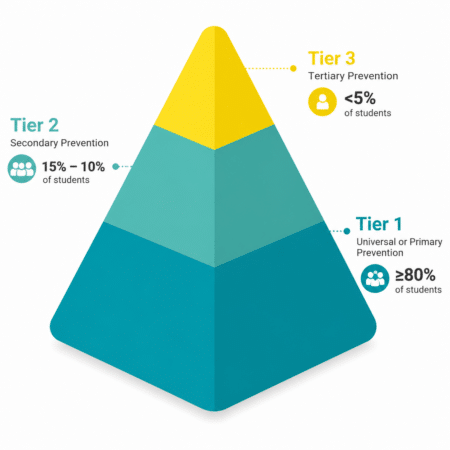
PBIS uses a three-tier approach. Each of these three tiers has applications to a specific subset of students.
Tier 1 – Most Students
Schools begin at Tier 1 by creating a behavior matrix outlining the positive behaviors that they wish to establish schoolwide. Depending on the school, positive behaviors might include simple actions such as walking calmly in line, throwing away trash in the cafeteria, or keeping a neat and tidy locker. As the school staff and students focus on these behavioral goals, teachers spend less time disciplining students and instructional time increases.
Approximately 80% of students never need to move beyond Tier 1 in interventions and support.
Characteristics of Tier 1 – Universal or Primary Prevention:
- Schoolwide
- For all students, staff members, and settings
- Designed to reduce problem behaviors
- Increases instructional time
Tier 2 – Some Students
About 15% of students benefit from additional targeted interventions. Tier 2 provides small-group supports that address the causes of students behavioral challenges, including social emotional, academic, or behavioral needs before concerns become more significant.
These efforts focus on specific groups of students and the underlying issues that may be causing the behavior and often complement existing PBIS programs to help schools strengthen academic support alongside behavior instruction.
Characteristics of Tier 2 – Secondary Prevention:
- Group supports for some students
- Specialized interventions for students demonstrating at-risk behavior
- Prevents worsening of problem behaviors
Tier 3 – Few Students
Students who do not respond to the interventions and support in Tier 2 receive further individualized supports in Tier 3. These interventions target students who exhibit high-risk behavior.
The individualized plan for each student at this level may include efforts by special education teachers or school psychologists. Typically, less than 5% of students require Tier 3 interventions.
Characteristics of Tier 3 – Tertiary Prevention:
- Individual support for a few students
- Specialized interventions for students with high-risk behavior
- Designed to reduce severity of ongoing problem behaviors
Establishing PBIS Schoolwide
A successful PBIS framework relies on a commitment from the entire staff, from administration to educators to support staff. It is most effective when adopted schoolwide.
Each school must identify the behavior expectations they want to develop among their students. Ideally, this is a short list of three to five behaviors. As the school identifies these core values, it also decides how those values might look in a variety of settings. For example, showing respect might mean that a student raises his hand in the classroom, follows rules on the playground, and uses table manners in the cafeteria.
The next step in the establishment and identification of these values is instruction. This is accomplished by posting setting-specific actions that align with the behavior expectations as well as intentional instruction in behavior that reflects these values. When students exhibit the desired behaviors, teachers offer recognition of these actions by awarding points. Students can redeem their accumulated points for rewards and/or privileges.
As the school moves through the instructional year, they consistently assess the effectiveness of their PBIS framework. This can include analysis of data such as office discipline referrals, teacher commitment to the program, attendance, and academic achievement.
When used schoolwide, PBIS changes the focus of discipline from punitive measures to positive interactions between students and staff. The positive interactions transfer into stronger relationships between the student and teacher and thus a better learning environment for all students.
Benefits of Schoolwide PBIS
Admittedly, PBIS can feel foreign to those familiar with traditional punitive discipline systems. But adopting a PBIS framework schoolwide can have incredible benefits:
- Improves school culture
- Builds social skills
- Reduces office discipline referrals
- Reduces suspensions
- Increases instructional time
- Improves social and emotional development
- Improves school safety
- Increases student engagement
- Improves academic performance
- Increases family involvement
- Improves faculty retention
- Improves classroom management
Adoption of a PBIS framework has the potential to create radical change in the climate of a struggling school. For educators who are seeking to reach and teach every student in their charge, PBIS makes it possible.
Assessing the Effectiveness of PBIS
Implementation of PBIS is only part of the equation. The other part is assessment. As a school implements PBIS in all areas, a wealth of data begins to accumulate.
Most schools using a PBIS framework enter into it with the twin goals of improving school climate and reducing office discipline referrals. Evaluating the data allows a school to see what is working and what still needs improvement.
Why PBIS?
PBIS recognizes that students learn behavior the same way they learn academics—through instruction, practice, and feedback. By replacing reactive discipline with prevention, schools create environments where students receive the behavioral and academic supports they need to succeed.
Whether schools are strengthening Tier 1 support, expanding positive behavior intervention strategies, or developing individualized support for students with greater needs, PBIS provides an evidence based framework that helps improve school climate, reduce problem behavior, and support long-term student success.
Ready to Simplify Your PBIS Implementation?
From recognizing positive behaviors to monitoring schoolwide trends and supporting data-driven decisions, PBIS Rewards makes implementing PBIS easier for educators. Request a demo and discover how your school can save time, strengthen implementation, and build a more positive school climate.